
DeKalb Parole and Probation
Parole and probation can both require reporting, treatment, travel approval, and compliance with court or agency rules, but they arise at different points. Parole is release from state prison before the sentence fully expires. The Georgia State Board of Pardons and Paroles makes parole decisions, while the Georgia Department of Community Supervision, or DCS, handles field supervision. Probation is a court sentence. State felony probation is commonly supervised by DCS, while DeKalb also has a local State Court Probation Department serving State, Magistrate, and Superior Courts.
| Record type | Who orders it | Best verification path |
|---|---|---|
| Parole | State Parole Board after prison custody | Parolee Database, Board records, and DCS |
| Felony probation | Sentencing court | Court disposition and DCS field office |
| Local court probation | DeKalb court | Court docket and DeKalb State Court Probation |
| Discharge | Supervising authority or court | Final order, discharge record, or agency confirmation |
- Parole
- Conditional release from prison while a sentence remains active.
- Probation
- Court-ordered community supervision, sometimes instead of incarceration.
- Absconder
- A person alleged to have stopped reporting or left supervision without permission.
- Detainer
- A request by another authority to hold or receive a person.
Verify DeKalb Release Supervision
Start with the custody path. A person released from DeKalb County Jail may be on bond, probation, time served, or transfer status and may never appear in a parole search. A person released from a GDC prison or reentry facility may have a parole record. The public Georgia Parolee Database accepts partial search terms and displays parole fields, including a parole begin date. It is the direct post-release tool for state parole, not a general list of everyone who left the county jail.
- Confirm the person’s full name and whether the last custody site was DeKalb County Jail or a GDC facility.
- Search the Parolee Database for a state parole record. Compare identifying and parole details rather than relying on name alone.
- Check the sentencing case in the DeKalb court system when probation, bond, or a court condition is more likely.
- Contact DCS for state supervision or DeKalb State Court Probation for the local court path.
- Ask for the final order or discharge record if the question is whether supervision ended.
A result should be read with the court disposition. A parole start date confirms one kind of supervised release. A probation order states the term and conditions set by the court. Neither record proves that a person is currently held at the jail. Current custody and post-release supervision are separate status questions.
DeKalb Supervision Office Paths
The DCS DeKalb field office serves DeKalb and the DeKalb Circuit. Despite its name, the office is in Conyers rather than Decatur. That matters when someone expects supervision services at the jail or county courthouse. DCS is the state path for parole and many felony probation cases.
DCS DeKalb Field Office981 East Freeway Drive SE, Suite A
Conyers, GA 30094
770-388-5929
Monday-Friday, 8:00 a.m.-4:30 p.m.
The DeKalb State Court Probation Department is a separate local path. Its courthouse location is in the Administrative Tower, Room 300, and its published phone is 404-371-2822. A second location operates at the Robert "Bobby" Burgess Building on Camp Circle. Use the court case and sentencing order to decide which office holds the relevant probation record.
DeKalb Violations and Warrants
A violation allegation does not automatically explain current custody. The supervising officer may report missed contact, travel without approval, a new arrest, or failure to complete a required program. A court or the Parole Board then follows the process that applies to that sentence. An absconder label generally means the agency alleges that the person stopped reporting or cannot be located. It is not the same as a new conviction.
No public DeKalb absconder list was identified. The Sheriff’s contact directory publishes Warrants Unit, Fugitive Unit, and 24-Hour Communications Center paths. Check a DeKalb court docket for a failure-to-appear or probation matter, use DCS for a state-supervision issue, and use Board channels for a parole warrant. VINELink may send custody-change notices when agency data supports them, but it is not a supervision-case file.
DeKalb Supervision Discharge Records
Supervision ends through the authority that imposed or administers it. For probation, the sentencing docket and final court order are the strongest records. For parole, confirm the result with the Board or DCS. A jail release sheet may show why a person left physical custody, but it does not replace a later parole or probation discharge record. “Released” therefore does not always mean the entire sentence has ended.
Georgia’s Open Records Act permits requests for nonexempt agency records and generally requires an initial response within three business days. A written request helps identify the person, case number, supervision type, and date range. Some supervision material may be restricted, redacted, or held by a different office. The central DeKalb County release records path can help separate jail, court, and state records before a request is sent.
DeKalb Parole Decision Records
A Tentative Parole Month, or TPM, is not a final release date. The Board’s TPM explanation and lookup describes it as the month for final review and possible parole release. Good conduct and required programs may remain conditions. Misconduct, unmet conditions, new information, or Board discretion can postpone or cancel the month.
Georgia parole eligibility also resists a simple percentage rule. O.C.G.A. § 42-9-45 supplies general eligibility rules, while serious violent felony and mandatory-minimum statutes can override them. A person may receive a TPM, a postponement, a denial, or parole to a detainer. Actual release is best confirmed only after GDC, Board, and DCS records change.
The Board’s monthly meeting notices are not an offender hearing calendar. Public meetings concern policy, operations, presentations, and Board business. Ordinary offender cases are not considered or decided at those meetings, so the TPM lookup and parolee database are more useful than searching meeting agendas for a named person.
DeKalb Reentry and Supervision
Metro Reentry Facility gives DeKalb a distinct state-release role beyond the county jail. GDC says the facility reopened in May 2018 as a male reentry facility serving returning citizens nearing release into metropolitan Atlanta. Its published capacity is 355. A person leaving that facility follows a state custody path, so GDC, the Parole Board, and DCS matter more than the county jail roster.
GDC’s Metro Reentry Facility page identifies its mission and population. The broader GDC release phase may include residential planning, release scheduling, benefits help, and release-card matters. Public Sheriff pages did not publish DeKalb jail property-pickup rules, so exact county property or account questions should go to jail operations rather than being inferred from state practice.
The image below shows the official DeKalb DCS field-office source used to confirm where state supervision is handled.
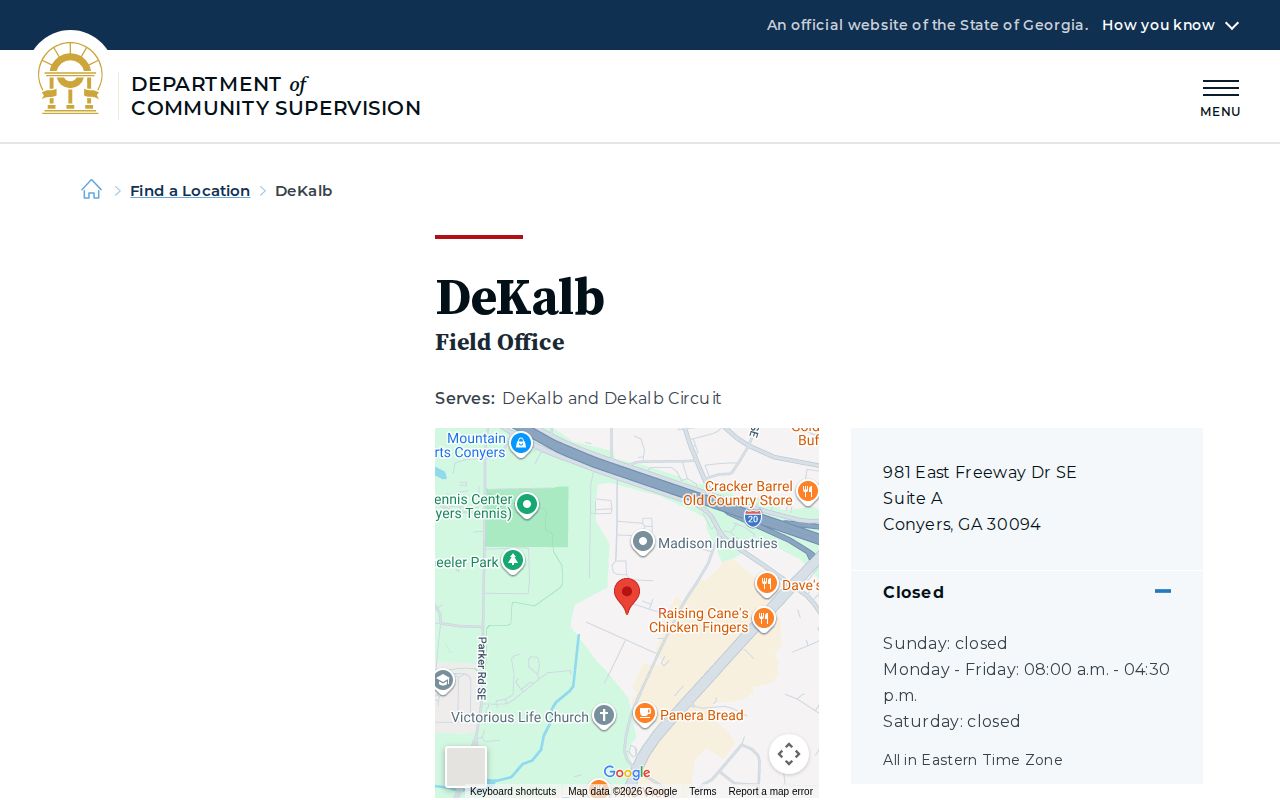
That regional office is the practical follow-up point when a DeKalb release leads to state parole or felony probation supervision.
DeKalb Supervision Record Chain
A complete check often needs three records. The custody record shows whether the person left DeKalb County Jail or GDC. The sentencing record states whether probation was ordered, how long it runs, and which court retains authority. The supervision record shows parole or probation activity after release. Each office answers only its part. Asking the Sheriff for a parole discharge, or asking the Parole Board for a county bond release, will not produce the needed document.
For county cases, use the DeKalb court system that handled the charge. Superior Court is the main felony path and offers the Odyssey civil, criminal, and jail portal. State Court provides criminal misdemeanor case search. Magistrate Court dockets can help with early case events. Match the case number, charge, disposition, and sentencing date. A docket entry can show a revocation petition, amended sentence, termination order, or warrant that changes how an old release should be understood.
For state cases, compare the GDC offender entry, TPM result if applicable, parolee search, and DCS office. A person can be out of prison yet still serving the balance of a sentence under parole rules. Another person can finish prison with no parole but begin a separate probation term imposed by the court. The phrase “off supervision” should be reserved for a final agency or court record, not inferred from silence in a public search.
Conditional transfer adds another layer. The Board may parole someone to a detainer held by another authority. That event ends custody at one Georgia facility but does not mean the person entered the community. If the receiving authority later releases the person before the Georgia sentence expires, parole supervision may then begin. Confirm both the transfer and the later release before describing the status.